Carrier HVAC Maintenance Plans in Pomona
Here is the answer Pomona Carrier HVAC runs seasonal Carrier maintenance across Pomona, CA ZIP 91768, including Hacienda and Ganesha Hills. A spring tune-up cleans the condenser coil, tests the $150 - $450 capacitor and contactor, and verifies charge before Zone 9 heat; a fall check covers the 59-series furnace, so call (213) 444-4051 or book online.
At a glance facts
- Maintenance across Pomona ZIPs 91766, 91767, 91768.
- Spring AC tune-up and fall furnace check, scheduled around the Zone 9 cooling season.
- Each visit tests capacitor microfarads, contactor, refrigerant charge, and condensate drain.
- Catches the $150 - $450 part before it becomes a peak-summer no-cool call.
- Documented service supports Carrier warranty requirements.
- Hours Weekdays 7am-6pm, weekends 8am-2pm; we book spring slots starting in late winter.
- Independent shop, licensed and insured. Plan pricing confirmed at booking.
What does Pomona heat do to a neglected Carrier system?
It accelerates every failure. A condenser coil caked with Santa Ana dust cannot reject heat, so head pressure climbs, the compressor runs hotter, and efficiency drops right when you need it. A run capacitor already drifting out of spec gives up on the first 100 F afternoon. A clogged condensate drain backs up and an open float switch shuts cooling off entirely. Maintenance is cheap insurance against all three.
What is on the spring tune-up checklist?
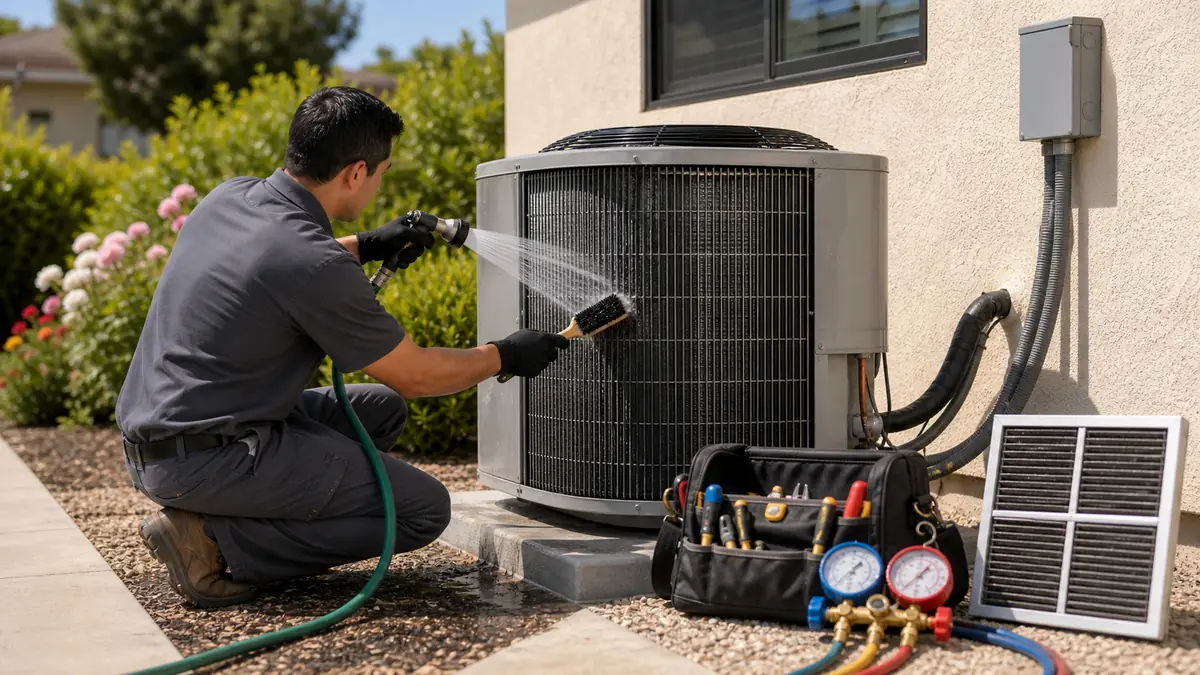
- Wash the outdoor condenser coil and clear debris from the cabinet.
- Test the dual-run capacitor microfarads and inspect the contactor for pitting.
- Verify refrigerant pressures, superheat, and subcooling against the Carrier charge chart.
- Clear the condensate drain and confirm the float safety switch trips.
- Check the ECM blower, filter, and static pressure, and pull any stored Infinity codes.
What is on the fall furnace check?
Pomona's heating season is short but the 59-series furnace still shares the indoor coil and blower with your AC, so a fall visit protects both sides. We inspect and clean the hot-surface igniter and flame sensor, the two parts behind most ignition lockouts (codes 14 and 34); test the inducer and pressure switch (code 31); and confirm the high-limit and rollout switches (codes 13, 33, and 26) operate. We check the heat exchanger for cracks, verify gas pressure and burner flame, and clear any stored flash codes off the amber LED before the first cold snap.
Which Carrier systems does the plan cover?
Any Carrier tier, with the checklist scaled to the equipment. On value 26SCA5 Comfort 16 and 26SCA4 Comfort 14 single-stage units, the visit is mostly coil cleaning, a capacitor and contactor check, and a charge verification. The two-stage 26TPA8 Performance 18 and 26SPA6 Performance 16 units add a staging check. On the 24VNA6 Infinity 26 and 26VNA1 Infinity 21 Greenspeed flagships and their Infinity System Control (SYSTXCCITC01), we also confirm the variable-speed compressor is modulating, the ECM blower is hitting its airflow targets, and the touchscreen is clear of 44, 54, 56, 178, and 179 faults, because a Greenspeed system that has quietly dropped to single-speed wastes the efficiency you paid for and a tune-up is where we catch it.
What can you do between maintenance visits?
A few homeowner habits stretch the value of a tune-up across a long Pomona cooling season. Change or wash the filter every one to three months during summer, because a clogged filter is the fastest way to starve the coil, freeze it, and trip a code 44 air-restriction alert on an Infinity control. Keep two feet of clearance around the outdoor condenser and rinse windblown Santa Ana grit off the fins with a gentle hose stream, never a pressure washer. Pour a cup of water down the condensate line and confirm it drains, and listen for new buzzing or grinding that signals a contactor or motor on its way out. None of this replaces the metered tests we run, but it keeps the system breathing between visits.
How does a plan compare to pay-as-you-go?
The math favors a plan when it prevents one peak-season emergency. A planned capacitor swap during a calm spring visit is routine; the same part on a 102 F Saturday with the house at 88 F is an urgent call. A plan also keeps your system at its rated efficiency and gives you priority scheduling during heat waves. Compare the repair lanes on the AC repair page, or read repair or replace if your unit is aging.
| Without a plan | With seasonal maintenance |
|---|---|
| Capacitor fails at peak heat | Caught and replaced in spring |
| Dirty coil drops efficiency all summer | Coil cleaned before the season |
| Emergency-rate diagnostic | Planned visit, priority booking |
| Lapsed warranty record on a failed part | Dated annual service documentation |
| SEER2 rating eroding on a fouled coil | Rated efficiency held all summer |
Why does Pomona heat make maintenance non-optional?
Pomona sits in Title-24 Climate Zone 9 near the Inland Empire transition, with 60 to 80 days a year at or above 90 F and regular 100 F-plus Santa Ana spikes. That climate punishes a neglected system in ways a coastal town never sees: the coil fouls faster with windblown grit, head pressure climbs sooner, and a capacitor drifting out of spec fails on the first triple-digit afternoon instead of limping through a mild summer. In the older Lincoln Park and Wilton Heights homes, the condenser often sits in a tight side yard with restricted airflow, so a clean coil and clear clearance matter even more. A spring visit is the cheapest way to keep a $150 - $450 part from becoming a peak-season no-cool call.
Pomona maintenance plan FAQ
When should I schedule a Carrier tune-up in Pomona?
Spring, before the first heat wave. Pomona starts hitting 90 F by April or May, so a March or April visit catches a weak capacitor and a dirty condenser coil before they fail at peak load. We add a fall furnace check for the 59-series side so you are covered both seasons in one plan.
What does a maintenance visit actually include?
We wash the condenser coil, test the run capacitor microfarads against spec, check the contactor for pitting, verify refrigerant pressures and superheat, clear the condensate drain, replace or check the filter, and pull any stored Carrier codes. The point is to catch the cheap part before it becomes a no-cool emergency.
Does maintenance keep my Carrier warranty valid?
It helps. Carrier warranties expect documented annual service, and a clogged coil or low charge that causes a failure can be cited as neglect. Our visit gives you a dated record. If a covered part fails, we tell you to use authorized service first so you do not lose the warranty coverage.
Is a plan worth it for a newer Carrier system?
Yes, mostly to protect efficiency. Even a two-year-old Infinity unit loses capacity when the Pomona dust and Santa Ana grit coat the coil, and a marginal capacitor in 100 F heat does not care how new the unit is. Maintenance keeps the SEER2 rating you paid for and shortens the odds of a peak-summer breakdown.
How often should a Carrier system be serviced in Pomona?
Twice a year for a heat-pump or a paired AC-and-furnace system: a spring AC tune-up before the Zone 9 heat and a fall furnace check before winter. A cooling-only system can run on one thorough spring visit. The point is to catch the cheap wear part on a calm day, since Pomona runs the equipment harder than coastal LA for 60 to 80 days a year.
What happens if I skip maintenance on my Carrier AC?
The failures stack and arrive at the worst time. A coil caked with Santa Ana grit cannot reject heat, so head pressure climbs and the compressor runs hot; a clogged condensate drain trips the float switch and stops cooling; and a drifting capacitor ($150 - $450) gives out on the first 102 F afternoon. None of those are dramatic on a spring morning, which is exactly why we catch them then.